
The conflict between spatial symmetry and relativity

Left and right. From our early years, we have had these two concepts drummed into our physical awareness through the hands we use for cutlery, the feet we use for shoes, or through traffic rules. It is rare to experience confusion when told to ‘turn right’ in everyday life, and left and right seem to be among the most fundamental and self-evident coordinate axes that structure our world, much like up and down or front and back.
Strangely, however, once we attempt to describe what is right as an objective definition without relying on metaphors involving specific objects, we suddenly find ourselves lost in a deep labyrinth. When specific external references—such as the position of the heart, the rotation of a clock, or the direction a compass points—are stripped away, it becomes extremely difficult to maintain the actual essence of the concepts of left and right.
Spatial mirror symmetry
The primary factor that makes defining left and right difficult is mirror-image symmetry (parity symmetry) in three-dimensional space.
The direction of up and down can be stipulated by the absolute physical gradient known as gravity. The direction of front and back is functionally defined for many living organisms as the direction of travel or the surface where sensory organs are concentrated. However, even after these two axes—up/down and front/back—are established, the left-right axis still leaves room for inversion. Right-handed and left-handed coordinate systems possess chirality (they do not overlap when reflected in a mirror), yet the geometric structures they possess are identical.
Consequently, any attempt to define right using only the geometric properties of space inevitably falls into a circular definition (such as ‘in a right-handed system...’) or must rely on another relative rotational direction like ‘clockwise’. Even if a galaxy existed somewhere in the universe where our ‘right’ and ‘left’ were swapped—like a world inside a mirror—the geometric laws there would function exactly the same as in our own world.
The linguistic limits of relative concepts
The second factor lies in the fact that the words left and right are inherently relative concepts that possess no internal standard.
For example, concepts such as a ‘circle’ or a ‘square’ can be completely defined by their internal properties alone—such as the distance from a center or the length of sides and angles—without borrowing any external criteria. In contrast, left and right always presuppose the existence of a subject: the observer.
If one attempts a dictionary definition, most rely on metaphors of geographical conditions or anatomical features, such as ‘the direction of east when facing north’ or ‘the side opposite the heart’. If one tries to verbalize these purely by excluding such references, one can only arrive at a tautology: ‘right is the opposite of left’. This suggests that left and right are ‘paired concepts’ defined only by their difference from each other—abstract symbols that cannot exist in isolation. In other words, left and right are not entities, but merely ‘labels’ assigned to relationships within space.
The Ozma Problem and a breakthrough in physics
The depth of this problem is symbolized by the Ozma Problem, introduced by physicist Martin Gardner. The question asks: If we were to contact an extraterrestrial civilization via radio communication alone, would it be possible to accurately convey to them what we mean by ‘right’?
In a situation where material samples cannot be sent and common celestial bodies cannot be observed, no amount of mathematical or logical explanation can communicate the distinction between left and right. This is because we cannot rule out the possibility that ‘clockwise’ in their culture is the opposite of ours, or that their hearts are on the right side.
A ray of light was cast upon this desperate situation by the Wu experiment conducted by Chien-Shiung Wu in 1956. Until then, the laws of physics were believed to be symmetrical (parity-invariant), but it was discovered that this symmetry is broken in the ‘weak interaction’ of subatomic particles. This phenomenon—where a bias occurs in the direction of emitted electrons during the decay of specific atomic nuclei—can serve as a universal physical standard anywhere in the cosmos.
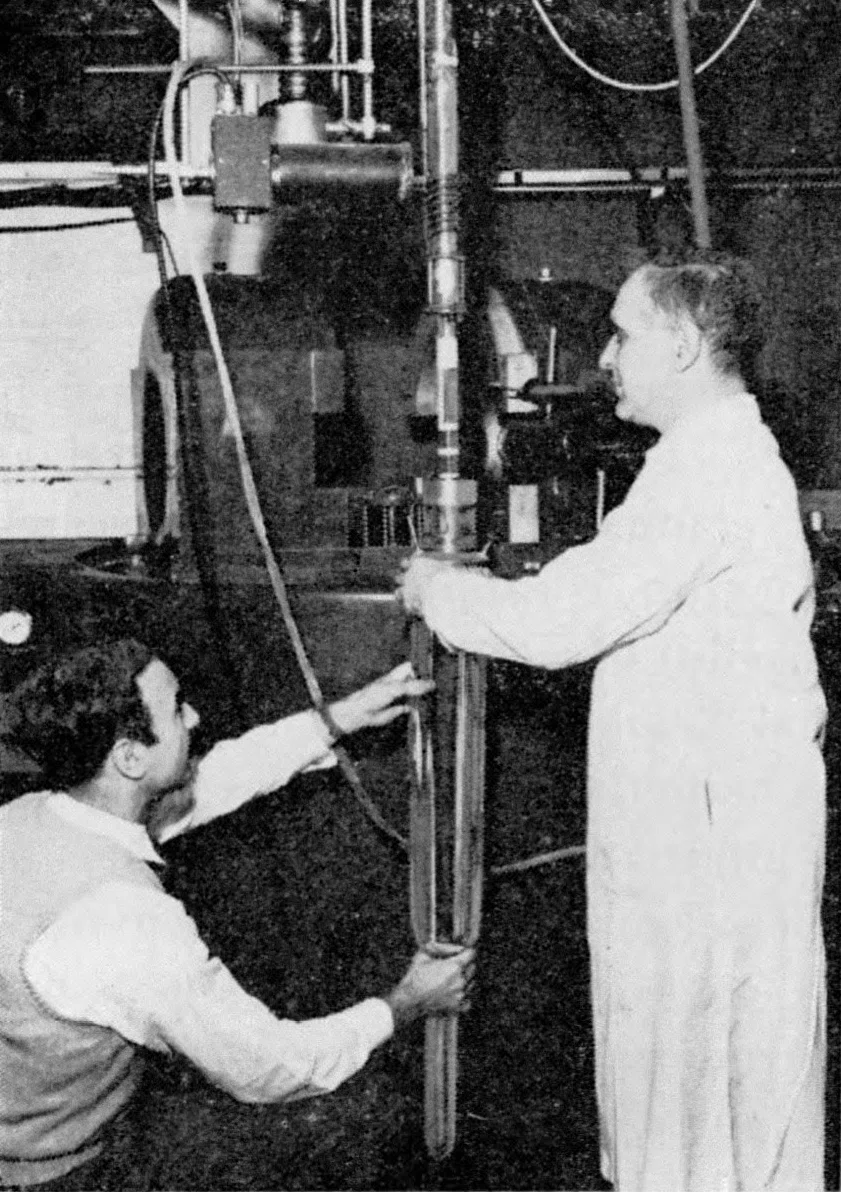
However, what was gained through this discovery was merely a universal ‘convention’ that let us call the direction in which many electrons fly ‘left’. Ultimately, even with the use of advanced physics, the definition of left and right must result in an ultimate ‘metaphor’ that takes some specific phenomenon as its standard.
Left and right as a measure of humanity
As is clear from these considerations, the reason defining left and right is so difficult is simply because the universe we inhabit ‘treats left and right equally’ at a fundamental level. Distinguishing between them and finding value or meaning in that distinction is largely a matter of convenience for the observer as humans, or life itself.
It is precisely because we possess an extremely ‘biased’ embodiment—with our hearts on the left, gripping pens with our right hands, and standing on the earth according to gravity—that we can perceive left and right as self-evident. The fact that we cannot define left and right without metaphors highlights how much our perception depends on concrete, physical experience.
The difficulty of defining left and right is the profound chasm that lies between the symmetry of the universe and the asymmetry of life, which cannot be fully captured by logic or mathematical formulae alone.


